
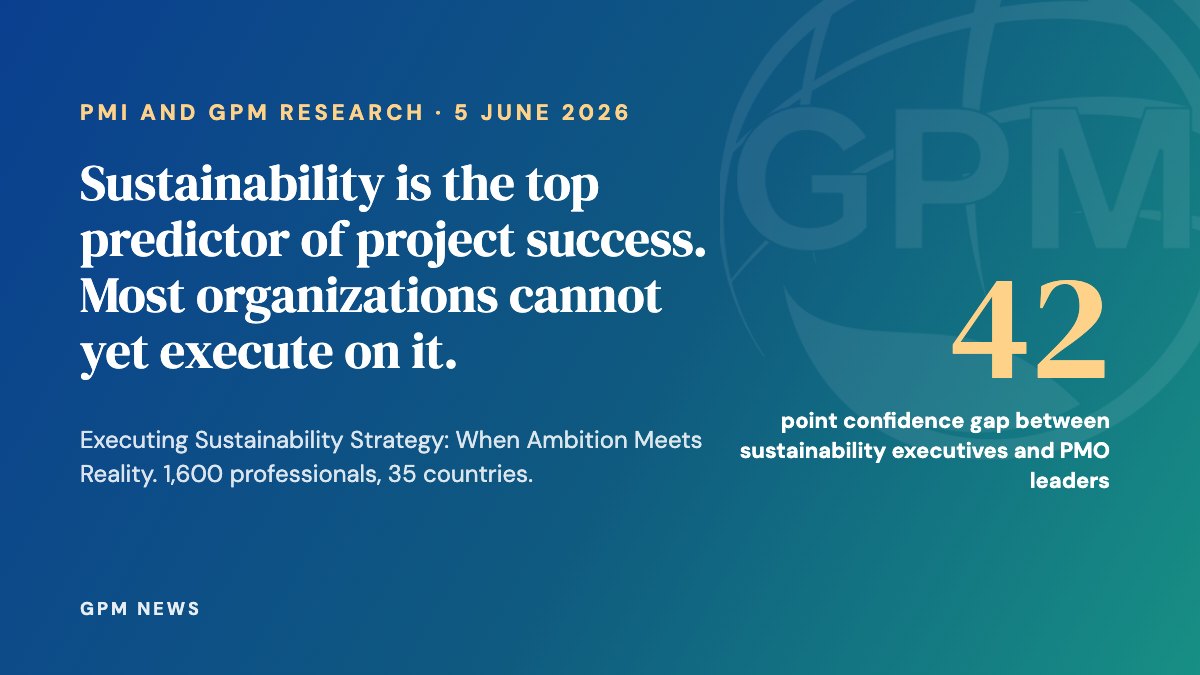
New research from PMI and GPM finds that sustainability is the strongest predictor of project success, and that most organizations are still unable to execute on it.
Published on 5 June 2026, Executing Sustainability Strategy: When Ambition Meets Reality draws on a survey of nearly 1,600 professionals in 35 countries, conducted in seven languages, with qualitative research among C-suite executives, sustainability leaders, PMO leaders, project professionals and sustainability skeptics. Projects built around sustainability succeed at nearly twice the rate of those that are not.
The gap between ambition and delivery
The headline finding is a confidence gap. 85 percent of sustainability executives are confident their organization can achieve its sustainability goals. Among the PMO leaders who have to deliver those goals through projects, 43 percent agree, a 42-point gap. Only 20 percent of project professionals are extremely confident. 79 percent of respondents say sustainability positions their organization for long-term success, yet 41 percent report that it is fully integrated across projects and functions, which leaves 59 percent of organizations running sustainability beside their projects rather than through them. Four in ten respondents qualify as sustainability skeptics.
The report identifies six friction points that separate strategy from delivery: difficulty quantifying sustainability benefits in business terms; weak integration into decision-making; inconsistent execution because goals are unclear; deprioritization under delivery pressure; limited visibility into how day-to-day actions drive impact; and the challenge of working against longer-term outcome horizons.
Two enablers
Two conditions separate the organizations that execute from the ones that only commit. The first is clear purpose from leadership, so that the people who set strategy and the teams who deliver it share one definition of project success, and sustainability enters the decisions that govern capital, talent and time. The second is organizational capability: the systems thinking and execution capacity to translate sustainability strategy into project-level decisions, workflows and measurable outcomes.
“Sustainability has often been a side agenda or a signaling exercise. But it is now increasingly tied to business resilience, competitiveness, and long-term value creation,” said Pierre Le Manh, President and CEO of PMI. “Our research shows that projects built around sustainability succeed at nearly twice the rate of those that are not. The challenge for leaders now, beyond embedding sustainability into strategy, is how to build the organizations to deliver on it.”
“Sustainability progress lives or dies at the project level,” said Dr. Joel Carboni, founder and president of GPM. “Every ton of emissions avoided, every resource conserved, every community made stronger by a project happens because a team had the skills, the standards and the will to deliver it.”
The CSPP launches the same day
The research was released on World Environment Day alongside the Certified Sustainable Project Professional (CSPP™), the PMI and GPM certification and e-learning program built on the P5 Standard. It equips practitioners to assess the sustainability dimensions of a project early and to carry them into planning, execution and measurement, with 260 ways to assess and manage sustainability-related risk.