
GPM Global · Public Notice · U.S. Service Mark Registration
U.S. Reg. No. 8,255,819 · International Class 41 · Registered May 12, 2026
↓ Download Registration CertificateGPM Ltd. has received U.S. registration for Sustainable Project Management® as a service mark in International Class 41 for business training in the field of professional development and project management. The registration is listed on the Principal Register as U.S. Registration No. 8,255,819, with first use and first use in commerce dating to July 12, 2011.
The registration recognizes the training services GPM has developed and delivered since 2011, supported by published standards, methods, and credentials used by organizations and practitioners around the world.
| Registrant | GPM Ltd. D.B.A GPM Global |
| Registration Number | 8,255,819 |
| Registration Date | May 12, 2026 |
| International Class | 41 |
| Services | Business training in the field of professional development and project management |
| First Use / In Commerce | July 12, 2011 |
| Serial Number | 98-663,585 (filed July 24, 2024) |
| Register | Principal Register, United States Patent and Trademark Office |
GPM pursued this registration because language matters. When a body of professional training is established and refined over time, the words used to describe it shape how organizations recognize it, evaluate it, and select it. For more than a decade, GPM has built the training services, standards, methods, and credentials that organizations and practitioners use to integrate sustainability into how projects are governed, planned, and delivered.
Sustainable Project Management® identifies the training services GPM has delivered since 2011 to help project professionals consider impacts across the project lifecycle, make better trade-off decisions, and connect project delivery to long-term outcomes within social, environmental, and economic thresholds.
Credibility in training rests on more than terminology. Organizations offering professional development in sustainable project management should themselves operate to the standards they teach. That means published sustainability policies, transparent reporting, demonstrated practice across their own operations, and training built on a body of standards work developed, tested, and refined over time.
GPM has held to that requirement since 2011. The organization has been a signatory to the United Nations Global Compact since 2012, publishes an annual Communication on Progress, issues a GRI Standards 2021 (Core Option) sustainability report, maintains a Net Positive Carbon Impact position externally verified by an accredited third party, and operates under a documented policy framework covering ethics, human rights, anti-trafficking, labor rights, environmental regeneration, and responsible AI. The P5 Standard for Sustainability in Project Management and the GPM SPM Practice Guide have been developed, peer-reviewed, and updated across multiple editions. The registration recognizes the training services built on that sustained body of work.
The registration is intended to support clarity in how the term is applied to training and professional development connected to GPM's standards-based approach. It does not constrain how universities, professional bodies, governments, companies, or practitioners discuss sustainability in projects. GPM partners remain free to use the mark in accordance with their agreements and GPM's published intellectual property guidance.
The registration supports clarity, consistency, and responsible use of the mark so the market understands which training programs and professional development offerings are delivered under GPM's standards-based approach.
The registration covers the composite mark as used to identify GPM's training services. No exclusive right is claimed in the term “project management” standing alone.
Through the PMI-GPM Joint Venture, professional development under Sustainable Project Management® will continue to be delivered as it was intended: as structured training that helps organizations build resiliency under conditions of uncertainty, equips practitioners to deliver projects within social, environmental, and economic thresholds, and connects project performance to long-term value.
The Joint Venture is the global vehicle through which GPM's standards, methods, and credentials reach the project management profession at scale. It positions Sustainable Project Management® training as governance-grade professional development that strengthens how organizations plan, deliver, and account for projects under increasing regulatory, environmental, and social pressure.
This registration reflects years of work by many people who recognized that project management needed to evolve. Projects shape the world people live in. The way they are managed matters.
Sustainable Project Management® reflects GPM's continued work to help professionals deliver projects that create lasting value across people, planet, prosperity, process, and product.
Our work continues.
Mark Usage Inquiries: Organizations seeking guidance on permitted use of Sustainable Project Management®, including Approved Training Partner arrangements and licensing under the PMI-GPM Joint Venture, may contact GPM directly.
GPM Global · 41592 Orianna Lane, Novi, MI 48375 USA ·
Dr. Joel Carboni Founder, GPM · Standards Builder · Regenerative Business Advocate Joel is widely recognized as a sustainability disruptor, standards builder, and global advocate for regenerative business practices. For more than three decades, he has worked at the intersection of sustainability, strategy, and governance, helping organizations translate ambitious sustainability goals into measurable, lasting impact. As the Founder of GPM (Green Project Management), Joel introduced the P5 Standard for Sustainability and the PRiSM methodology — pioneering frameworks that redefine how projects deliver value by integrating environmental, social, and governance considerations into project delivery. These models have since become recognized standards within leading global institutions, including the Project Management Institute (PMI) and the Institute of Management Accountants (IMA). Joel also contributes to the global sustainability agenda through his work with the Global Reporting Initiative (GRI), where he is involved in developing the new Pollution Standard, and through contributions related to the Paris Agreement and the UN Sustainable Development Goals. Beyond his work as a practitioner and standards developer, Joel is a Forbes contributor, a visiting professor at SKEMA Business School, and an advisor to governments and multinational organizations on how to embed ethics, sustainability, and regenerative thinking into business strategy and delivery. Recognition In 2025, Joel was recognized by Thinkers50 as a finalist for the inaugural Regenerative Business Award for his book Becoming Regenerative.
JC
GPM Founder P5 Standard PRiSM GRI Forbes Contributor SKEMA Business School Thinkers50 UN SDGs
Announcement · Certification Transition
Effective June 5
On June 5, the Green Project Manager – Basic (GPM-b™) becomes the Certified Sustainable Project Professional (CSPP™).
The GPM-b™ was established in 2013 as the first sustainability certification for project professionals. Thousands of practitioners adopted it and applied its principles across industries, geographies, and project types. It created a foundation where none existed and moved sustainability from concept into execution within the project lifecycle.
The CSPP™ reflects how the profession has matured. Sustainability is now embedded across governance, planning, decision-making, and delivery. It operates as a knowledge area that intersects with cost, risk, schedule, quality, and value realization. The scope spans labor and working conditions, community impacts, emissions, resource use, compliance, ethics, and adaptive governance. These domains influence outcomes, performance, and long-term project viability.
The certification is built for practitioners responsible for delivering outcomes under real constraints. It focuses on tools, methods, and decision frameworks that apply within active projects and integrate into existing delivery models without requiring parallel systems or separate processes. It aligns with the PMI Gold Standard Certification format, strengthening its structure and recognition across the global project management community.
The CSPP™ is the only certification backed by two global leaders: PMI, the world’s leading professional organization for project management, and GPM, the global leader in Sustainable Project Management™ practice.
Projects are the point of execution for strategy, policy, and investment. Embedding sustainability at that level is how organizations move from stated intent to measurable outcomes. The CSPP™ is how the profession makes that commitment operational.
Updated: April 2026


GPM® is proud to announce that we have earned accreditation from the International Accreditors for Continuing Education and Training (IACET). This achievement places GPM among a select group of training providers worldwide that meet the ANSI/IACET 1-2018 Standard—the most rigorous and internationally recognized benchmark for continuing education.
With this accreditation, GPM is authorized to award IACET Continuing Education Units (CEUs) across our expanding ecosystem of programs:
Professional Certificate in Regenerative Leadership — delivered directly through GPM.
Sustainable Project Management™ Training — delivered through the Project Management Institute (PMI) and PMI’s global Accredited Training Partner network.
Leadership in Sustainable Business — delivered through the Institute of Management Accountants (IMA).
This strengthens the entire GPM learning network and ensures that every partner who delivers our content does so within a globally validated educational framework.
IACET accreditation is independent confirmation that GPM’s educational systems, assessments, governance, and learner support meet international quality standards.
It ensures:
Recognized CEUs accepted by employers, universities, licensing bodies, and professional associations.
Consistent learning quality across GPM, PMI, IMA, and all delivery partners.
Clear, measurable learning outcomes grounded in proven instructional design.
Confidence for organizations that their teams are learning from programs aligned with global best practice.
You can trust that every GPM-connected program offers:
A verified standard of educational quality
Competence-based assessments
CEUs that support professional licenses, certifications, and academic equivalencies
A consistent experience regardless of where you take the course
Whether you’re advancing your career, maintaining credentials, or building new capabilities, your learning is now backed by internationally recognized assurance.
For employers and institutions, the accreditation provides:
External validation of training quality
Reduced risk in procurement and compliance
Measurable outcomes aligned with ANSI/IACET standards
Confidence that sustainability and leadership training meets global expectations
It strengthens the case for investing in capability-building across sustainability, regenerative leadership, and organizational governance.
GPM’s accreditation lifts the entire ecosystem of partners who deliver our programs.
For PMI, IMA, and our broader training network, this accreditation provides:
The ability to offer courses backed by IACET CEUs
A stronger position in corporate, government, and NGO bids
A consistent, accredited framework across all delivery channels
A verified level of instructional rigor built into every program
Enhanced credibility when working with enterprise clients and institutions worldwide
This is a step forward for the entire network — not just GPM.
Earning IACET accreditation required a full-system audit of:
Instructional design and adult learning methods
Competence-based assessment frameworks
Faculty qualifications and oversight
Accessibility, learner support, and administrative processes
Governance, ethics, quality assurance, and data integrity
The result is a documented, externally validated educational ecosystem built for consistency, reliability, and real-world impact.
IACET accreditation aligns directly with our mission. It strengthens GPM’s ability to build capability, governance, and accountability across institutions worldwide by ensuring that every learning experience we deliver — whether through GPM, PMI, IMA, or our global partners — meets a verified international standard. This accreditation reinforces the integrity of our work and expands our capacity to support organizations and professionals driving regenerative outcomes.
GPM® is the global authority on regenerative and sustainability-integrated governance for projects, organizations, and leadership. Operating in more than 55 countries, GPM provides internationally recognized standards, training, certifications, and advisory services that enable organizations to thrive while contributing to ecological and societal well-being. GPM is the creator of the P5 Standard, PRiSM™ methodology, the Sustainability Competence Standard, and the Project Sustainability Reporting Guide.

FOR IMMEDIATE RELEASE — November 12, 2025
Honoring standout projects, partners, and individuals driving sustainable project management worldwide—and looking ahead to the 2026 Awards
GPM Global today announced the full slate of winners for the 2025 GPM® Global Sustainability Awards, celebrating exemplary leadership and measurable impact across projects, partnerships, and individual contributions. From transformative infrastructure to grassroots education and corporate change-making, this year’s honorees exemplify how the GPM P5 Standard turns ambition into action. We congratulate every winner and finalist and are already looking forward to recognizing the next wave of leaders in the 2026 Awards.
Cypark Resources Berhad — Danau Tok Uban (DTU) Floating Solar Power Plant, Malaysia. Recognized for technical excellence and a holistic approach that blends environmental stewardship, community well‑being, and regional economic benefits. Highlights include resilience through major site and weather challenges and meaningful local engagement that amplified long‑term value.
Innovatel (Italy). GPM’s first Accredited Training Partner in Italy, Innovatel is honored for sustained leadership in building national capacity for sustainable project management—through accredited courses, chapter collaborations, and applied P5 work—under the hands‑on leadership of Prassede Colombo.
Gold: Felipe Moraes Borges (Brazil) — For integrating sustainability across an extensive portfolio and advancing practical tools such as the “Sustainability Project Canvas.”
Silver: Ahmad Almulla (UAE) — For institutionalizing sustainability within TAQA Transmission via a P5‑based framework and data‑driven performance tracking.
Bronze: Manohar Yerraguntla (India) — For leading India’s first large‑scale battery recycling project with exceptional circular‑economy performance and a scalable ESG‑PMO model.
Gold: Eman Ali Deabil (Bahrain) — For global knowledge leadership, including the Green PMO Global Collaborative Book and large‑scale education on Green PMO models.
Silver: Aymen Salah (Tunisia) — For translating climate knowledge into community‑owned action—from youth education tools to municipal climate planning—aligned to the GPM P5 Standard.
Bronze: Kawther MEKNI (Tunisia) — For energizing public engagement through initiatives like GreenDay for a Sustainable Nation and experiential learning for circularity.
Gold: Duyen Le (SKEMA Business School, France) — For a visionary thesis on space sustainability and orbital debris grounded in P5’s planet dimension.
Silver: Mohammad Fallah (Iran University of Science and Technology) — For a comprehensive urban surface water management project in Tehran with strong P5 integration and community benefits.
Bronze: Kinga Irena Żabicka (Wrocław University of Science and Technology, Poland) — For a practical roadmap to embed sustainable project management in the IT sector using P5 and PRiSM™.
This year’s honorees demonstrate that sustainability is not an add‑on—it’s the engine of durable project value, resilient organizations, and thriving communities. On behalf of our global community, congratulations to all our winners and contributors to the 2025 GPM Global Sustainability Awards.
We’re excited to continue elevating best practices, tools, and leaders in the year ahead—and we look forward to celebrating new achievements in the 2026 GPM Global Sustainability Awards.
About GPM Global
GPM Global advances sustainability in project management worldwide through standards, certifications, education, and assurance, including the GPM P5 Standard and PRiSM™ methodology, to help organizations deliver projects that benefit People, Planet, and Prosperity. (Category and winner information verified from official 2025 award materials.)

In Memoriam · GPM Global
Director of Certification, GPM Global
It is with deep sadness that GPM Global announces the passing of William (Bill) Duncan, our Director of Certification, respected colleague, and dear friend.
Rest in peace, Duncan. Your legacy will continue to guide us.
Bill’s contributions to the profession of project management are immeasurable. Best known as the primary author of the original PMBOK® Guide, published by the Project Management Institute (PMI), Bill helped lay the foundation for modern project management as it is practiced around the world today. His vision, clarity, and insistence on practical application transformed what was once a loosely defined discipline into a recognized global profession.
Throughout his career, Duncan remained a steadfast advocate for advancing the profession through standards, ethics, and competence. He was a key contributor to many International Project Management Association (IPMA) standards and served for 17 years as Director of Standards for the American Society for the Advancement of Project Management (asapm/IPMA-USA), where his leadership and rigor helped shape performance-based competency frameworks that continue to guide practitioners globally.
At GPM, Bill brought that same brilliance and commitment to excellence. As our Director of Certification, he played a vital role in developing and refining the GPM Competence Standard, the Complexity Framework, and successive editions of both the P5™ Standard for Sustainability in Project Management and the GPM Practice Guide. His editorial precision and uncompromising standards for quality elevated every publication and piece of training material he touched.
Duncan’s influence extended far beyond his written work. He was a mentor, a teacher, and a trusted advisor — known for his sharp intellect, his humor, and his refusal to accept “good enough.” His colleagues and students will remember him for his generosity with knowledge, his storytelling, and his passion for helping others think more clearly and act with integrity.
While the global project management community has lost one of its true pioneers, Bill’s impact will endure through the frameworks he built, the organizations he strengthened, and the professionals he inspired. His work lives on in every project manager who values competence, clarity, and ethics in their practice.
We extend our deepest condolences to his family, friends, and all who had the privilege of learning from or working alongside him.


For its dedicated and effective work, we present the 2025 GPM Partner of the Year Award to Innovatel from Italy.
A statement from the Ewa Bednarczyk GPM VP, Partner Enablement:
"Innovatel has been a consistent and effective partner since becoming our first Accredited Training Partner in Italy. They have demonstrated a strong commitment to integrating GPM principles into the professional community through training, events, and collaborations. Their work is a clear example of how a dedicated partner can build local capacity for sustainable project management. At the center of this effort is Prassede Colombo, whose leadership has been essential to their success.”
Innovatel: a record of consistent progress
As GPM’s first Accredited Training Partner (ATP) in Italy, Innovatel has established a strong record of promoting sustainability in the nation’s project management landscape.
Innovatel’s commitment is formalized through its legal status as a Benefit Company, requiring it to pursue positive social and environmental outcomes. The company measures and discloses its progress annually through a public Impact Report.
Their work has expanded through collaborations with the PMI Northern and Southern Italy Chapters, where they have delivered courses and webinars like the "Green Project Management Journey." They are also a consistent participant in the national "Festival dello Sviluppo Sostenibile" (Festival of Sustainable Development), organizing events such as "Sustainability in Action" to connect businesses and associations.
Innovatel has also worked to introduce sustainability principles to the Business Analysis field, contributing articles and presenting at events for the International Institute of Business Analysis (IIBA). A clear example of their hands-on work is their collaboration with the circular economy association Giacimenti Urbani, where they are applying the GPM P5 Standard to help define processes and measure the impact of sustainability initiatives.
Recognizing Effective Leadership
While this award recognizes Innovatel as an organization, its achievements are directly linked to the leadership of Prassede Colombo. Prassede's consistent efforts have been fundamental to Innovatel's impact. She has personally led training courses and webinars, equipping professionals with the tools for sustainable project management. As a frequent speaker and presenter, she has brought the principles of sustainable project management to diverse audiences, including the PMI chapters in Italy and the international Business Analysis community through IIBA. Her hands-on involvement is evident in key initiatives, from organizing Innovatel's successful annual event at the 'Festival dello Sviluppo Sostenibile' to guiding the practical application of the GPM P5 Standard with partner associations like Giacimenti Urbani. We acknowledge her vital role in driving the success of this partnership.
Please join us in congratulating Prassede Colombo and the Innovatel team for this recognition.
The GPM Global Team

GPM® Position Statement
 Clarifying the Record
We appreciate that the recent IPMA publication acknowledges the role the P5™ Standard has played in shaping how projects measure and manage sustainability. For fifteen years, P5 has been freely available and continuously refined through practitioner feedback, research, and thousands of real-world applications. The book correctly highlights many of its strengths, but also includes several statements that do not accurately reflect the intent or current evolution of the standard.
Because readers were not offered GPM’s perspective before publication — nor were we notified of its inclusion — we believe it is important to clarify a few points so that the profession has a complete understanding of what P5 represents today.
“Provides an extensive checklist” — Incorrect
P5 is extensive, but it is not a checklist. It is a dynamic assessment framework containing 49 elements across five lenses, yielding 245 ways to analyze and manage project impacts. Each element interacts with others, producing a multi-dimensional view of performance. Checklists confirm completion; P5 enables measurement, insight, and improvement.
“The assessment is complex” — Context matters
Every credible sustainability assurance process is complex. Meaningful impact evaluation cannot be reduced to a few boxes to tick. ESG disclosures, integrated reporting, and sustainability assurance all require depth, data, and context. P5’s structure allows teams to tailor indicators while maintaining methodological integrity. Its depth is what allows accuracy and comparability. The assessment is bespoke and scalable, not complicated for complexity’s sake. Our model is the basis for actual sustainability reporting, not academic exercises.
“Drifts away from its initial goals as a PSIA method” — False
P5 was conceived to make sustainability measurable throughout the project life cycle — and that goal remains unchanged. What has evolved is the integration of assessment with planning, governance, and reporting through the Sustainability Management Plan (SMP). The method has matured from an isolated impact analysis into a comprehensive management approach. That is advancement, not drift.
“Has a very normative character, less open for tailoring” — Clarification
Normative frameworks are what make professional practice reliable. Without defined principles and expectations, there is no assurance of quality or comparability. At the same time, P5 is explicitly flexible: the Applications section and free templates show how indicators can be tailored by industry, scale, and context. Normativity provides the foundation; tailoring builds on it. They are not opposites — they are complementary.
We acknowledge the positive comments made about P5 and appreciate the recognition of its contributions. Out of respect for the book’s disclaimer that no portion may be reproduced, we have refrained from quoting its text directly. Readers who wish to review the original commentary can purchase the 54-euro volume.
For those who want to see the source material, the P5™ Standard can be read at no cost on our website and downloaded — together with its accompanying templates — for free. It is also available through PMI’s website as part of our collaboration to embed sustainability into project management education.
For more than fifteen years, P5 has helped practitioners bring accountability and transparency to project delivery. It continues to evolve through feedback from thousands of professionals worldwide and is now accelerating further through collaboration with PMI.
Ours remains free, open, and field-tested. Readers can decide for themselves which approach truly advances the profession.

GPM is on a mission to elevate sustainable project management globally—and we just took a major leap forward. In April 2025, GPM entered into a strategic joint venture with the Project Management Institute (PMI). This game-changing partnership combines GPM’s leadership in sustainability with PMI’s unmatched global reach and credibility. Together, we’re delivering more value, more opportunity, and more recognition for certified professionals.
Effective immediately:
The RPL GPM-b exam will be proctored and administered by Pearson VUE, the global leader in computer-based testing.
The full GPM certification exam will also transition to Pearson VUE in the coming weeks. Stay tuned for the official launch date.
If you currently hold an active GPM-b certification, you now have access to our updated digital badge.
If your certification is already connected to LinkedIn, the new badge should already be reflected on your profile.
You can renew your certification through PMI with a quick exam retake—this is the shortest path to staying certified.
Going forward, you’ll maintain your credential with PDUs (Professional Development Units).
If your certification has lapsed, you do not need to retake the full course or exam.
Simply complete the recertification process through PMI. PDUs will keep you current moving forward.
Starting now, GPM-b certifications issued through PMI will be backed by both PMI and GPM—a global first in the project management space.
This dual-backing means that your certification carries the strength, credibility, and recognition of two global leaders in project and sustainability management. There’s nothing else like it out there.
If you currently hold a GPM-b certification issued by GPM, it is fully valid, recognized, and equal to any GPM-b credential issued by PMI. Your renewal process will run through PMI now and when you renew, it will be a PMI Certifiication. Curious when that will be? Check here. Can you renew early? Absolutely.
Do you need to? No. Remember. Same credibility. Same value. Same mission.
(And hey, let’s not forget—we’re the OGs in sustainable project management™. )
This is just the beginning of a stronger, more sustainable future for project professionals.
We’re excited to have you on this journey with us.

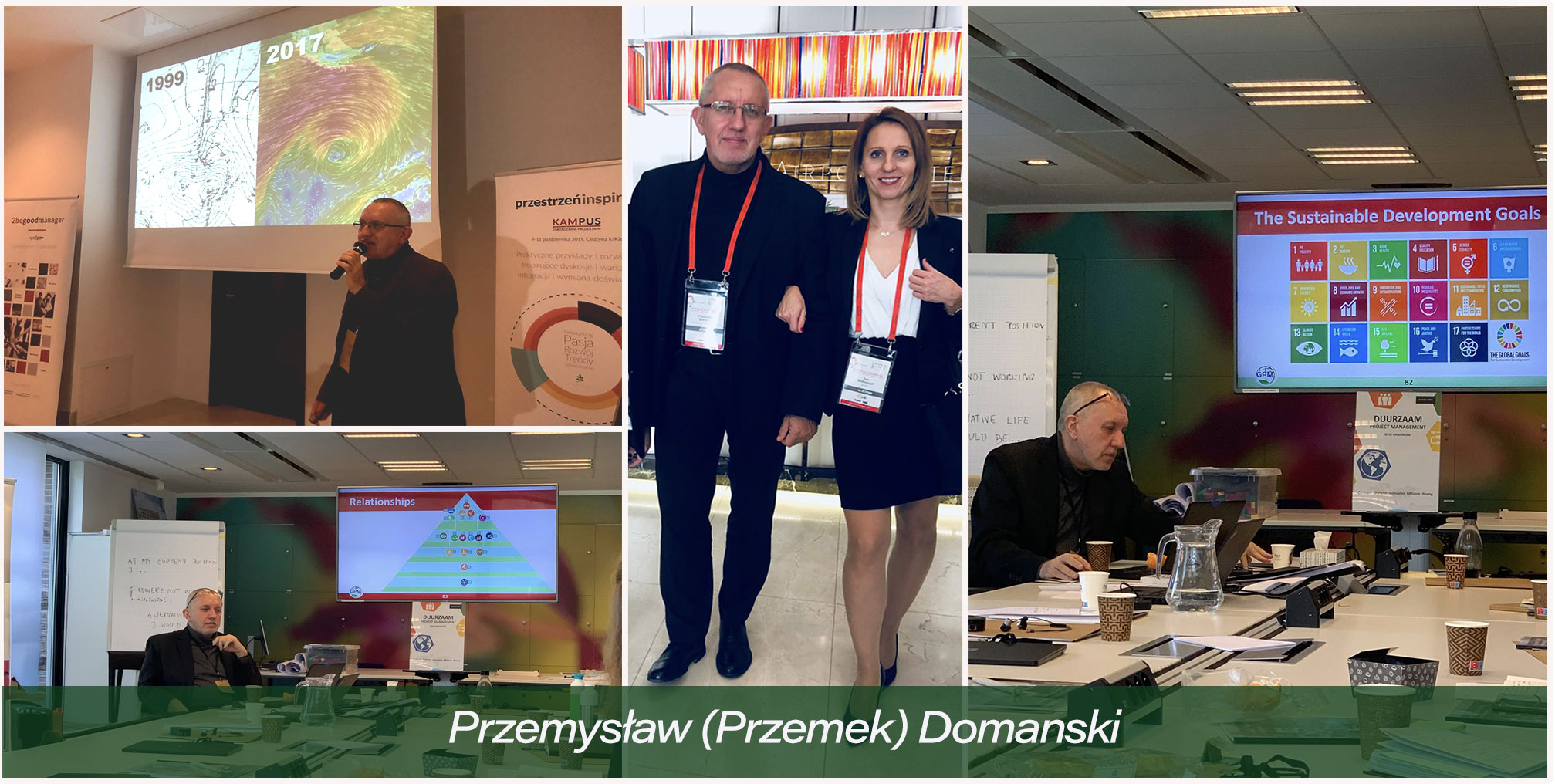
With deep sadness and boundless gratitude, GPM Global announces the passing of our dear friend and colleague, Przemysław “Przemek” Domański, on 11 July 2025.
Przemek was a founding member of GPM EMEA and a passionate advocate for sustainable project management in Poland and across the region. As an early adopter and tireless educator, he helped define what it meant to manage projects with purpose, responsibility, and impact. His contributions were far-reaching — from training Accredited Training Partners (ATPs) to mentoring sustainability leaders, Przemek elevated the profession not through ego, but through generosity, precision, and an unwavering belief in human potential.
“Przemek believed that if we gave people the tools, the heart, and the space to lead, they would rise. He didn’t just talk about regenerative development — he lived it. And in doing so, he made all of us better.”
— Dr. Joel B. Carboni, Founder & President, GPM
“Przemek was always focused and committed only to subjects close to his heart: striving for excellence, sustainability and, above all, community support. Working with him was pure pleasure and a beautiful adventure. He had the incredible ability to look at problems from an unconventional perspective. This helped us to find very creative and practical solutions, which allowed us to grow in our professional lives as well as serve others.”
-Ewa Bednarczyk, Vice President, GPM Global
Przemek was instrumental in translating global standards into local action, helping project professionals in Eastern and Central Europe align their practices with the P5 Standard and regenerative principles. But it wasn’t just what he taught — it was how he made you feel. Valued. Heard. Empowered.
To honor Przemek’s life and legacy, GPM Global will plant 500 trees in his memory — a regenerative tribute for a man who helped cultivate the very roots of our movement. His legacy will live on in every sustainably managed project, every student he mentored, and every seed of change he inspired.
Przemek leaves behind a wife and son, to whom we extend our deepest condolences and enduring support. Our global community mourns with them, and celebrates the extraordinary life of a man who made sustainability not just a goal, but a way of being.
He will be deeply missed, always remembered, and forever honored.

As a participant in the UN Global Compact since February 2013, GPM Global has consistently gone beyond compliance — we’ve helped shape the global sustainability conversation. As the pioneer in sustainable project management, we don’t just advocate for change — we architect it. From authoring the P5 Standard and PRiSM™ methodology to contributing to the development of global frameworks such as the SDGs, GRI, and TNFD, we have worked tirelessly to mainstream sustainability into how projects are initiated, planned, and executed.
But we believe leadership is more than publishing thought pieces or trending hashtags. It’s about walking the talk. That’s why our 2025 COP reflects tangible, measurable action:
We achieved Net Positive carbon performance, removing more carbon than we emitted through verified methods such as direct air capture and reforestation.
We embedded sustainability into every client engagement through the P5 Standard, including environmental, social, and governance due diligence as standard practice.
We deepened our circular economy work, guiding organizations toward circular certification and regenerative business models.
We extended oversight across our entire value chain, ensuring anti-corruption, equity, and environmental stewardship are not optional — they’re non-negotiable.
This year’s report also openly discusses the challenges we face — from increasing complexity in supply chain transparency to the urgent need for better governance standards globally. But challenges don’t deter us — they sharpen our resolve.
As we look ahead to 2026 and beyond, we will continue to strengthen our own house — not just as the global thought leader on this topic, but as a trusted partner that models the very principles we advocate. Because at GPM, we hold ourselves to the same standards we encourage others to meet. Sustainability is not a statement — it’s a structure. And it must be built intentionally.
We invite you to explore our COP, reflect on our progress, and hold us accountable — as we will continue to hold ourselves.
Visit our UNGC page here where you can review our committments and download our 2025 COP.

Making projects sustainable on a global scale since 2009.
© 2009–2026 GPM Global. All rights reserved.
GPM®, Green Project Management®, and Sustainable Project Management® are registered trademarks of GPM Ltd. PRiSM™, the PMI-GPM P5™ Standard for Sustainability in Project Management, the PMI-GPM Practice Guide for Sustainability in Project Management, CSPP™ (formerly GPM-b™), CSPMs™, CSPMx™, CSP™, CSF™, Certified Sustainable Project Manager (Expert)™, GPM360°™, GPM360°™, and PSM3™ are trademarks of GPM Global and the PMI-GPM Joint Venture as applicable. Use requires written consent.