Ambassador sign in
What GPM helps with
GPM is the sustainability organization advancing regenerative practices worldwide, and the creator of the P5 Standard, PRiSM and the CSPP certification. Organizations come to GPM when a sustainability commitment has been made at the top and has to be delivered through projects, programs and portfolios. The help usually falls into one of four kinds, and most engagements combine two of them.
Advisory
Policy, governance and method
Sustainability written into the business case, gate reviews, procurement rules and the delivery method your teams already use, so commitments survive contact with delivery.
Assessment
PSM3 and project verification
PSM3 measures how far sustainability is embedded across a portfolio or PMO. GPM360° verifies a single project against the P5 Standard.
Training
Courses for teams and leaders
GPM's courses through the learning portal or an Accredited Training Partner in your region, then certification for project leads and the sustainability team.
PMO support
Catalyst PMO
Hands-on help standing up or re-tooling a PMO so it can carry sustainability requirements through every project it governs.
How it works
Tell us what you need
Use the form below. Two or three sentences about your organization and the problem are enough. There is no charge for this step.
We reply within two working days
A member of GPM's team reads every request and writes back with questions or a proposed time for a call. You will hear from a person, not an automated queue.
A 30-minute conversation
We work out together whether the need is advisory, assessment, training or something else, and what a first piece of work would look like. If GPM is not the right fit, we say so and point you elsewhere.
A written proposal
Scope, approach, timeline and fee in one document, built on the P5 Standard and the guides GPM writes for the PMI-GPM joint venture. You decide from there.
The form
A few lines about your organization and the problem you want solved. GPM reads every request and replies within two working days.
Questions
Who should use this form?
Anyone who wants GPM's help with an organization rather than a personal certification: executives, PMO directors, portfolio and program leads, sustainability managers, procurement and public bodies. If you are an individual looking for training or certification, the Start here page will get you there faster.
What does it cost to ask?
Nothing. The form, the reply and the first conversation are free. Fees apply only once you accept a written proposal.
How quickly will GPM respond?
Within two working days. Requests arrive at
Does GPM work outside the United States?
Yes. GPM works with organizations worldwide, in person and remotely, and through Accredited Training Partners in many regions and languages.
What information should I include?
Your organization and sector, the size of the portfolio or team involved, what you are trying to achieve or fix, and any deadline that matters, for example a reporting cycle, a board date or a regulatory requirement. Anything you send is treated as confidential.
Can I ask about something small?
Yes. A half-day sponsor briefing, a review of one Sustainability Management Plan or a single PSM3 assessment are all normal requests.
Page updated 5 September 2026.
GPM®, Green Project Management® and Sustainable Project Management® are registered trademarks of GPM Ltd. PRiSM™, P5™, CSPP™, CSPMs™, CSPMx™, CSP™, CSF™, GPM360°™ and PSM3™ are trademarks of GPM Global and, where applicable, PMI-GPM. PMI and PMBOK are registered marks of the Project Management Institute.
Before you write
If you want to see how GPM thinks about organizations first, read the guide to sustainability in project management or look at the PSM3 assessment. Neither is required; the form works on its own.
Two or three questions
GPM publishes a lot: an impact standard, a method, four guides, a competence standard, five certifications, research and more than 250 essays. Nobody needs all of it at once. Answer two or three questions and you will get the one thing to do next; or pick a door below and read the whole path, four steps with one action at each.
The five paths. Each one is written out below, in order.
4 steps
I manage projects
Four steps from reading the standard to holding a certification, each one you can do this month.
4 steps
I work in sustainability
GPM's standards and certifications for the sustainability professional in any business function.
4 steps
I need help for my organization
From the case for projects to a conversation with GPM, then a measured, trained and reporting organization.
4 steps
I teach, train or research
The standards are free to use in teaching; the partner programs add accreditation and material.
3 steps
I need to verify a certification
Two registries, one minute.
Path · I manage projects
Who this is for. Project, program and portfolio managers who have to deliver sustainability through their projects.
Read the P5 Standard
Start with the overview and the People, Planet and Prosperity categories. The standard is free, it is the one PMI publishes with GPM, and twenty minutes is enough to see how impacts become project requirements. Open the P5 Standard.
Run one P5 Impact Analysis
Take a live project and score the 52 elements for the product and the process with the free workbook. You will find two or three impacts nobody had written down. That is the point. Download the P5 Impact Analysis workbook.
Write the Sustainability Management Plan
Put the analysis, the commitments, the owners and the measures into the plan. The template is free and follows the Practice Guide; the plan runs from the business case to benefits realization. The Sustainability Management Plan and template.
Choose your certification
The CSPP proves you know the standard, by exam, through PMI. The CSPMs proves you have delivered with it, from your own project evidence. Most people take the CSPP first and the CSPMs after a project or two. Compare the CSPP and the CSPMs.
Also on this path: The Practice Guide, PRiSM, the method, The Reporting Guide.
Path · I work in sustainability
Who this is for. Sustainability, ESG, procurement, operations, HR and finance professionals whose work is not project management.
Read the P5 Standard for Business Practice
The same 52-element impact standard, written for how an organization runs rather than for a single project. Free. It is the standard your CSF or CSP portfolio is measured against. Open the P5 Standard for Business Practice.
Read Sustainability in Practice
GPM's professional standard for people who do sustainability work: what competent practice looks like, function by function. Free, with print and Kindle editions. Open Sustainability in Practice.
Take the Regenerative Leadership course
GPM's Professional Certificate in Regenerative Leadership covers the eight competence units of the Sustainability Competence Standard: assessing impacts, designing regenerative systems, leading change and measuring results. Self-paced, online, 3.4 IACET-accredited CEUs. Programs of this kind are priced in the thousands elsewhere. GPM's is US$499. Take the course.
Certify: CSF or CSP
Read the competence units on the learning portal first, at no cost; if you can point to real outputs for most of them, you are ready. The CSF is for people who carry out the work; the CSP for people who lead it. Both are evidence-based: your own documents, an assessor, an interview, no exam. Valid for five years. Compare the CSF and the CSP.
Also on this path: The Sustainability Competence Standard, About the Regenerative Leadership certificate, The glossary.
Path · I need help for my organization
Who this is for. Executives, PMO directors, portfolio leads, sustainability managers and public bodies that have made a commitment and need it delivered through projects.
Understand why projects are the lever
The guide to sustainability in project management explains, in plain terms, why strategies are delivered or lost in projects and what the four layers, impact, method, competence and reporting, do. Read the guide.
Measure where you stand with PSM3
GPM's maturity assessment for portfolios and PMOs: where sustainability is already embedded, where it is asserted, and what to fix first. PSM3 organizational assessment.
Tell GPM what you need
Advisory on policy, governance and method; PSM3 or GPM360° assessment; training for teams and leaders; PMO support. Use the form, a person replies within two working days, and the first conversation is free. Get help from GPM.
Train, certify and report
GPM's courses through the learning portal or an Accredited Training Partner in your region, certification for the project leads and the sustainability team, and results reported with the Reporting Guide. Assessment, advisory and training for organizations.
Also on this path: The Sponsorship Guide, The Reporting Guide, GPM Consulting, The PMI-GPM joint venture.
Path · I teach, train or research
Who this is for. University faculty, corporate trainers, training companies and researchers.
Use the standards in your teaching
The P5 Standard, the Practice Guide and the Sustainability Management Plan template are free to download and cite. The interactive ecosystem map shows how they fit together in one picture. The interactive ecosystem.
Join the University Partner Program
For faculties that teach project management or sustainability and want GPM's material, cases and certification pathways for students. University Partner Program.
Become an Accredited Training Partner
Deliver GPM's IACET-accredited courses and CSPP preparation in your region and language. Accredited Training Partner program.
Draw on the research
Insights into Sustainable Project Management® with the Association for Project Management, Executing Sustainability Strategy with PMI, and the Perspectives journal, running since 2015. Insights research.
Also on this path: Perspectives, Glossary of 231 terms, How to cite GPM.
Path · I need to verify a certification
Who this is for. Employers, clients and recruiters checking a candidate's GPM certification.
Search the GPM registry
Every GPM-issued certification, by name or number: the certification, its number, the dates and whether it is active. No account needed. Search the registry.
CSPP holders: check PMI's registry
The CSPP is issued by PMI, so current holders appear in PMI's certification registry. Holders who transferred from the GPM-b appear there once their record has been sent across. PMI certification registry.
Know what you are looking at
Five certifications, two kinds of assessment. The comparison page shows who each is for, how it is assessed and how long it is valid. The five certifications compared.
Just exploring
Five pages, in order, for someone who wants to understand GPM before choosing anything.
Stop 1
What is GPM?
The organization in five minutes: identity, what it does, how it works with PMI.
Stop 2
Sustainability in project management
The subject in one guide, with GPM's definition and the four layers.
Stop 3
The P5 Standard
The impact standard, free, in its fourth version.
Stop 4
PMI-GPM
What the joint venture publishes and who does what.
Stop 5
Perspectives
Essays from GPM since 2015. Pick one and see how GPM thinks.
Questions
Where should a complete beginner start?
With the P5 Standard. It is free, it is short enough to read in a sitting, and every other piece on this site refers back to it. If you manage projects, follow the first path on this page; if your work is sustainability in another function, follow the second.
Do I have to pay for anything to get started?
No. The standards, the guides, the Sustainability Management Plan template and the P5 Impact Analysis workbook are free, and enrolment on the learning portal is free so you can read every certification criterion before you decide. Courses, certification assessments and organizational assessments are paid.
How long does each path take?
The reading in each path is a few hours. Running a first P5 Impact Analysis and writing a first plan takes a working week alongside a live project. Certification portfolios take most candidates four to eight weeks; the CSPP exam depends on the preparation course you choose.
Can I follow more than one path?
Yes. A PMO leader often follows the organization path and the project path at once; a sustainability manager who also runs projects may take the CSP and later the CSPMs. Every path ends in the same two places, a certification and the Ambassador network.
Page updated 5 September 2026.
GPM®, Green Project Management® and Sustainable Project Management® are registered trademarks of GPM Ltd. PRiSM™, P5™, CSPP™, CSPMs™, CSPMx™, CSP™, CSF™, GPM360°™ and PSM3™ are trademarks of GPM Global and, where applicable, PMI-GPM. PMI and PMBOK are registered marks of the Project Management Institute.
Lost on another page?
Most pages on this site carry a small "you are here" strip that names the path they belong to and the next step. The interactive ecosystem shows the whole system in one picture.
Why this joint venture exists
The Project Management Institute states its purpose as to maximize project success to elevate our world, and its vision as a world where every project lives up to its full potential for positive impact. GPM has spent seventeen years building the standards, methods and certifications that make positive impact something a project team can specify, measure and deliver. In April 2025 the two organizations put those things together.
Our joint vision is to make PMI's vision a reality by bringing GPM's unmatched expertise in Sustainable Project Management® to the world's largest community of project professionals, and elevating our world with them. PMI brings the reach: millions of professionals, thousands of organizations, academic institutions, training providers and governments. GPM brings the substance: the P5 Standard, the PRiSM method, the practice guides, the competence standard and the certifications that sit on top of them.
2025
joint venture formed
5
free publications
3
certifications in one family
1,600
professionals in the 2026 research
35
countries surveyed
In their words
"Sustainability transformation is one of the biggest challenges of our time, and it won't happen without projects. This joint venture is about placing project professionals at the center of that transformation. With GPM's certifications, learning programs and standards now brought into a joint venture fully integrated into the PMI organization, we are in a strong position to help our community turn good intentions into meaningful, measurable action, across industries and on a global scale. Our goal is to make sustainability practical at the project level and to equip professionals and organizations to lead their own sustainability journeys toward a more resilient and prosperous future."
Pierre Le Manh, President and CEO, Project Management Institute
"The future of project management must move beyond delivering outputs. Projects must play a critical role in generating prosperity, restoring ecosystems and building more equitable communities. This joint venture brings us closer to making sustainability and regeneration core to the profession."
Dr. Joel Carboni, Founder and President, GPM
From the joint announcement of 7 April 2025. Read the full release at pmi.org.
What we publish together
Every publication below is a PMI-GPM publication: written by GPM, published by the joint venture, and available free from GPM and from PMI. Together they form one system: the impact standard, the method, the sponsor's governance, the reporting bridge and the competence standard for the people doing the work.
 Impact standardThe PMI GPM P5 Standard for Sustainability in Project Management, Version 4.052 impact elements across People, Planet and Prosperity, five lenses, thresholds and crosswalks to GRI, ISSB and the SDGs. April 2026.
 MethodThe PMI GPM Practice Guide for Sustainability in Project Management, Fourth EditionHow the P5 Standard is applied through the six PRiSM phases, with the Sustainability Management Plan and templates. 209 pages, April 2026.
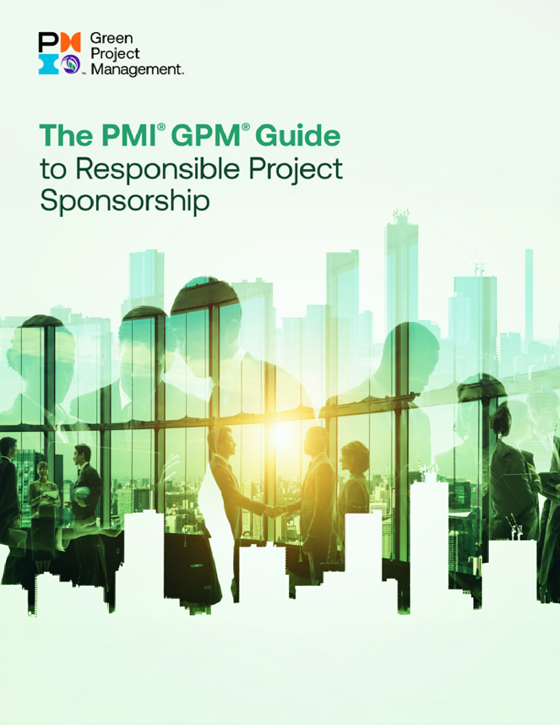 GovernanceThe PMI GPM Guide to Responsible Project SponsorshipFor the people who authorize projects: the STEWARD model of seven accountabilities and the four gate decisions. August 2026.
 ReportingThe Project Sustainability Reporting GuideCarries project impact data into GRI, ISSB, CSRD and SDG disclosures so that sustainability is managed first and reported second.
 CompetenceThe GPM Sustainability Competence Standard, Version 2.1Ten performance-based units defining what sustainability leaders and project managers must be able to do, with evidence.
The interactive ecosystem map shows how the five fit together, station by station. PMI hosts the same publications at pmi.org/learning/sustainability.
Certification

The Certified Sustainable Project Professional (CSPP) is the joint venture's certification, delivered through PMI since June 5, 2026. It tests knowledge of the P5 method and replaced the GPM-b, the first sustainability certification for project professionals, which GPM established in 2013. Above it sit the competence-based CSPMs and CSPMx, which assess evidence from real projects against the Sustainability Competence Standard; they belong to PMI-GPM and are administered by GPM.
Foundation
CSPP, Certified Sustainable Project Professional
Exam-based, delivered through PMI. The entry point for project professionals who want sustainability in their toolkit.
Specialist
CSPMs, Certified Sustainable Project Manager, Specialist
Competence-based, evidence from moderately complex projects, administered by GPM.
Expert
CSPMx, Certified Sustainable Project Manager, Expert
Competence-based, evidence from highly complex projects, programs and portfolios, administered by GPM.
Beyond projects
CSF and CSP
GPM's own certifications for sustainability professionals in any function, outside the joint venture.
Research
Published on June 5, 2026, the joint venture's first research report surveyed nearly 1,600 professionals in 35 countries in seven languages. Projects built around sustainability succeed at nearly twice the rate of those without it. Eighty-five percent of sustainability executives are confident their organization can deliver on its sustainability commitments; 43 percent of PMO leaders agree, a 42-point gap between the people who set the strategy and the people who run the projects. Only 41 percent of organizations have integrated sustainability into how projects are run; the rest manage it alongside.
The report names six friction points, from the difficulty of quantifying sustainability benefits in business terms to the longer horizons of sustainability outcomes, and two enablers: a clear purpose from leadership with sustainability embedded in capital, talent and time decisions, and the organizational capability to turn strategy into project-level decisions and measurable results. That second enabler is what the joint venture's standards, method and certifications exist to build.
"Sustainability progress lives or dies at the project level. Every ton of emissions avoided happens because a team had the skills, standards and will to deliver it."
Dr. Joel Carboni, Founder and President, GPM
Who does what
| What it does | Where to find it | |
|---|---|---|
| PMI-GPM, the joint venture | Publishes the P5 Standard, the Practice Guide, the Reporting Guide, the Sponsorship Guide and the Competence Standard; owns the CSPP, CSPMs and CSPMx certification family; publishes joint research. | pmi.org/learning/sustainability and gpm.org |
| PMI | Distributes the publications to its global community, delivers the CSPP exam through its certification infrastructure, and carries sustainability into its research and learning programs. | pmi.org |
| GPM | Writes the standards and builds the courses for the joint venture; administers the CSPMs and CSPMx; runs its own research and advisory work, the CSF and CSP certifications, the PSM3 and GPM360° assessments, the Ambassador program, and its own standards for business and professional practice. | gpm.org |
The result for a project professional is simple: one set of standards, available everywhere PMI reaches, written by the people who created the field's impact standard and method, with a certification path that starts with an exam and ends with evidence.
Milestones
| When | What happened |
|---|---|
| 2022 | PMI begins offering GPM's Sustainable Project Management® course with the GPM-b exam to its community. |
| 7 April 2025 | PMI and GPM announce the joint venture. GPM's standards, guides, tools, learning and certifications move into PMI-GPM. |
| December 2025 | The Project Sustainability Reporting Guide is published. |
| 22 April 2026 | Earth Day release of the P5 Standard, Version 4.0, and the Practice Guide, Fourth Edition, the first editions to carry both names. |
| 5 June 2026 | The GPM-b becomes the Certified Sustainable Project Professional (CSPP), delivered through PMI. Executing Sustainability Strategy is published the same day. |
| 14 August 2026 | The PMI GPM Guide to Responsible Project Sponsorship is released, the first joint publication written for the people who authorize projects. |
The dated record of every GPM standard and edition, back to 2008, is on the Provenance page.
Where to start
Read
Download the P5 Standard and the Practice Guide
Free, from GPM or PMI. Start with the standard to learn what a project must account for, then the guide to learn how.
Certify
Take the CSPP through PMI
The entry certification for sustainability in project management, on PMI's platform.
Apply
Bring GPM in
Advisory, P5 tailoring, PSM3 maturity assessment and GPM360° project certification for organizations that want the system installed.
Questions
What is PMI-GPM?
PMI-GPM is the joint venture formed in April 2025 by the Project Management Institute and Green Project Management (GPM). GPM's standards, guides, tools, frameworks, learning and certifications for sustainability in project management were brought into the joint venture, in which PMI holds the majority stake and GPM a minority stake for at least five years. GPM writes the standards and builds the courses for the joint venture and continues its own research and advisory work.
What does the joint venture publish?
The PMI GPM P5 Standard for Sustainability in Project Management (Version 4.0, April 2026), the PMI GPM Practice Guide for Sustainability in Project Management (Fourth Edition, April 2026), the Project Sustainability Reporting Guide, the PMI GPM Guide to Responsible Project Sponsorship (August 2026) and the GPM Sustainability Competence Standard. All are free to download from GPM and from PMI.
Which certification does PMI-GPM offer?
The Certified Sustainable Project Professional (CSPP), delivered through PMI since June 5, 2026. It replaced the GPM-b, which GPM had offered since 2013. The competence-based CSPMs and CSPMx certifications also belong to PMI-GPM and are administered by GPM until they move to PMI's platform.
What does GPM still do on its own?
GPM remains an independent sustainability organization that advances regenerative practices. It writes the standards and builds the courses for PMI-GPM, keeps its research and advisory work, publishes the P5 Standard for Sustainability in Business Practice and Sustainability in Practice, and runs the CSF and CSP certifications, the PSM3 and GPM360° assessments and the Ambassador program.
Where do I get the standards?
From GPM's standards library at gpm.org or from PMI's sustainability pages at pmi.org/learning/sustainability. The PDFs are free; no membership is required.
What research has the joint venture published?
Executing Sustainability Strategy: When Ambition Meets Reality (June 2026), based on nearly 1,600 professionals in 35 countries, found that projects built around sustainability succeed at nearly twice the rate of those without it, and that 85 percent of sustainability executives are confident in their organization's ability to deliver against 43 percent of PMO leaders.
I held a GPM-b. What happens to it?
The GPM-b became the CSPP on June 5, 2026. GPM-b holders can reinstate and upgrade; the steps are on the CSPP transition pages linked from GPM's certification hub.
Page updated 5 September 2026.
GPM®, Green Project Management® and Sustainable Project Management® are registered trademarks of GPM Ltd. PRiSM™, P5™, CSPP™, CSPMs™, CSPMx™, CSP™, CSF™, GPM360°™ and PSM3™ are trademarks of GPM Global and, where applicable, PMI-GPM. PMI and PMBOK are registered marks of the Project Management Institute.
Also on this site
Green Project Management (GPM): the organization. Standards and publications: the full library. Certifications: the whole family. Strategic alliances: PMI and GPM's other partners.
The organization
GPM, Green Project Management®, is the organization that writes the standards, method and competence requirements for sustainability in project management and certifies people and organizations against them. It was founded in May 2009 in Fort Wayne, Indiana, as a think tank of practitioners, incorporated as GPM Ltd. in April 2011, and launched its certification program in June 2011. It joined the UN Global Compact in 2013, the first project management organization to do so.
GPM's position is simple and has not changed since 2009: projects are where an organization's sustainability commitments are either delivered or lost, so the project profession needs an impact standard, a method and a competence standard of its own, with evidence at every step. Everything GPM writes serves that position. The standards and guides are free to download; the training, assessment and certification that apply them are what GPM sells.
Since 2023 GPM has worked with the Project Management Institute, and since April 2025 the P5 Standard, the Sustainability Competence Standard and the practice guides are PMI-GPM publications, delivered with the CSPP certification through PMI's global infrastructure. GPM remains an independent sustainability organization that advances regenerative practices: it writes the standards and builds the courses for PMI-GPM, keeps its research and advisory work, and publishes its own organizational standards and assessments.
The name and the marks
GPM® and Green Project Management® are registered trademarks of GPM Ltd. and are the organization's name. When someone searches for green project management they usually mean reducing the environmental impact of projects. GPM's work has always been wider than that: the P5 Standard assesses People, Planet and Prosperity together, for the product a project delivers and the process that delivers it, and it has since 2014.
Sustainable Project Management® is GPM's registered service mark for its method, training, assessment and certifications (US Reg. No. 8,255,819, in commerce since July 12, 2011). The subject itself is called sustainability in project management on this site. The mark has its own page; the subject has a guide.
What GPM writes
Standard
The PMI GPM P5 Standard for Sustainability in Project Management
Version 4.0 (2026). 52 impact elements, five lenses, crosswalked to GRI, TCFD, ISSB and the SDGs. First published 2014. Free.
Method
PRiSM and the Sustainability Management Plan
Six-phase delivery method with the P5 Impact Analysis at Discovery and Delivery. Named 2011, published 2013, the basis of the Practice Guide.
Standard
The GPM Sustainability Competence Standard
Version 2.1. Ten competence units with evidence-based performance criteria, the basis of GPM's competence-based certifications.
Guides
The PMI GPM practice guides
The Practice Guide, Fourth Edition; the Guide to Responsible Project Sponsorship; the Project Sustainability Reporting Guide. All free.
Research
Insights into Sustainable Project Management®
With the Association for Project Management: more than 10,000 responses across 113 countries on what practitioners actually do.
Record
Provenance
The dated record of every edition, launch and recognition from 2008 to 2026, with where each can be checked.
What GPM offers
Training
Sustainable Project Management® training
IACET-accredited courses on the P5 Impact Analysis, the Sustainability Management Plan and PRiSM, online and through Accredited Training Partners worldwide.
Certifications
CSPP, CSF, CSP, CSPMs, CSPMx
The exam-based CSPP (established 2013 as the GPM-b) and four competence-based certifications assessed on real results against the Competence Standard.
Assessment
PSM3, OSEM and GPM360°
Maturity assessment for portfolios, enterprise assessment against the P5 Standard for Business Practice, and single-project verification led by a Lead Assessor and validated by GPM.
Policies
Sixteen published policies
Ethics and conduct, environment and AI, privacy and data, intellectual property, each published in full and dated.
Questions
What does GPM stand for?
Green Project Management®. GPM® and Green Project Management® are registered trademarks of GPM Ltd., and GPM is the name the organization uses. The legal entity is GPM Ltd., an Indiana corporation.
When was GPM founded?
In May 2009, as a think tank of practitioners in Fort Wayne, Indiana, working from the P5 framework and the Sustainability Management Plan toolkit. GPM was incorporated in April 2011 and launched certification in June 2011.
Is GPM part of PMI?
No. GPM is an independent organization. Since 2023 it has partnered with the Project Management Institute, and since April 2025 the P5 Standard and the practice guides are PMI-GPM publications and the CSPP certification is delivered through PMI-GPM. GPM continues to publish its own standards and to certify against them.
Is Green Project Management only about the environment?
No. The name dates from 2009, when the environmental impact of projects was the visible gap. GPM's P5 Standard has always assessed People, Planet and Prosperity together, for both the product and the process. Environmental impact is one part of what GPM measures.
What is the difference between GPM and Sustainable Project Management®?
GPM is the organization. Sustainable Project Management® is one of its registered service marks, used for its method, training, assessment and certifications. Green Project Management® is the organization's own registered name.
Who founded GPM?
Joel Carboni, who wrote the first Project Sustainability Management Plan in 2008, founded GPM in 2009 and remains its CEO. He is the author of the P5 Standard, PRiSM and the reference guides.
Author
Dr. Joel Carboni is the founder and president of GPM and the architect of the standards, methods, and certifications behind Sustainable Project Management®, delivered through the PMI-GPM joint venture. He created the P5 Standard, the Sustainability Competence Standard, the Sustainable Project Management® Practice Guide, the Project Sustainability Reporting Guide and the PMI GPM Guide to Responsible Project Sponsorship. For over 30 years, his work has moved the profession in a different direction. A Forbes Business Council member and Global Reporting Initiative (GRI) contributor, he was shortlisted for Thinkers50's inaugural regenerative business award in 2025 for his book Becoming Regenerative.
Published 4 September 2026. Corrections through the contact page.
Also on this site
What is GPM: purpose and structure. Timeline: the story since 2009. Strategic alliances: the PMI-GPM joint venture and other partners. UN engagement: Global Compact participation since 2013.
What it means
Sustainability in project management is the practice of identifying, measuring and managing a project's impacts on people, planet and prosperity, for both the product it delivers and the process that delivers it, and treating those impacts as project requirements with evidence, from the business case to benefits realization.
It is done with three things: an impact standard, the P5 Standard, which says what a project must account for; a delivery method, PRiSM, which says when the impacts are assessed and decided; and one document, the Sustainability Management Plan, which carries the commitments, their owners and the evidence from the first gate to the last review. All three are published by GPM and free to read.
Every project changes the world it lands in. It uses materials, energy, money and people's time; it produces an asset, a service or a change; and that product goes on to have effects for as long as it exists. Sustainability in project management means identifying those effects on people, planet and prosperity before and during the project, measuring them against a baseline, and managing them as project requirements with the same discipline as scope, schedule and cost.
Two perspectives matter, and they are often confused. The product perspective asks what the deliverable will do across its lifespan and how it will be serviced, maintained and eventually retired. The process perspective asks how the project itself is run: how efficiently it uses resources, how effectively it reaches its outcomes, and how fairly it treats the people who do the work and the people affected by it. A wind farm can be a good product delivered by a poor process; a data center can be a well-run project that delivers a product with a heavy lifetime footprint. Both perspectives have to be assessed.
GPM's definition sets a measurable floor. A project is sustainable when every material impact is at baseline or better after the agreed responses. Regeneration goes further: a measurable enhancement of system capacity beyond the baseline, demonstrated with evidence, never asserted. This is why GPM's standards use words like baseline, threshold, indicator and verification rather than aspiration.
How GPM defined its method, 2013
Sustainable Project Management®, GPM's method, is the application of methods, tools and techniques to achieve a stated objective while considering the project outcome's entire life cycle to ensure a net positive environmental, social and economic impact.
GPM published this definition of its method in the GPM Reference Guide for Sustainability in Project Management (May 2013) and has carried it through PRiSM, the P5 Standard and the PMI-GPM Practice Guide. GPM, founded in May 2009, is the sustainability organization advancing regenerative practices worldwide, and the creator of the P5 Standard, PRiSM and the CSPP certification.
A note on the words. Many people search for Sustainable Project Management®. That phrase is GPM's registered mark (US Reg. No. 8255819) for its method, training, assessment and certifications. The practice itself, which any project team can carry out with the free standards, is sustainability in project management, and that is what this guide describes.
Why it is a project question
Organizations set targets at the enterprise level: net zero by a date, no deforestation in the supply chain, a share of revenue from sustainable products. None of those targets is met by the target. They are met, or missed, by the portfolio of projects that build the assets, change the processes and launch the products. If the project business case, requirements and gate decisions do not carry the sustainability requirement, the target quietly leaves the plan at the first schedule squeeze.
Disclosure rules have made this visible. GRI, the ISSB standards, the EU's CSRD and CSDDD and the EU Taxonomy ask for evidence of impacts, due diligence and outcomes. That evidence is produced, or not produced, at the project level. GPM's research with the Association for Project Management, based on more than 10,000 responses across 113 countries, documents how impact analysis, Sustainability Management Plans and governance are actually used across sectors, and where they are missing. Those gaps are what GPM's publications are written to close.
Sponsors matter as much as project managers. The person who authorizes a project, decides whether it continues, changes its mandate or stops it is the person who decides whether an impact is accepted. The PMI GPM Guide to Responsible Project Sponsorship sets out seven accountabilities for that role, including the sustainability decisions a sponsor owns.
How GPM structures it
GPM keeps four layers distinct, because mixing them is how sustainability programs collapse into slogans. Each layer has its own published document, and each document does one job.
Impact
The P5 Standard
What a project must account for: 52 impact elements across People, Planet and Prosperity, examined through five lenses, with baselines, indicators and crosswalks to GRI, TCFD, ISSB and the SDGs. Version 4.0, 2026.
Method
PRiSM and the Sustainability Management Plan
How a project is delivered against the standard: six phases, a P5 Impact Analysis at Discovery and again at Delivery, and one plan that carries commitments, monitoring and verification to closure and beyond.
Competence
The Sustainability Competence Standard
What a person must be able to do: 10 competence units with evidence-based performance criteria, two practitioner tracks, the basis for GPM's competence-based certifications. Version 2.1.
Reporting
The Project Sustainability Reporting Guide
How project evidence reaches the organization's disclosures: each lifecycle phase mapped to GRI, ISSB, CSRD, CSDDD, EU Taxonomy and SDG reporting through the Sustainability Management Plan.
Governance sits across all four. The PSM3 maturity assessment scores how well an organization's portfolio, programs and projects apply them, from 0 to 5 with evidence, and gives a roadmap for the gap.
How it is measured
Measurement starts with the P5 Impact Analysis. The team works through the 52 elements of the P5 Standard, grouped under People (labor practices and decent work, society and customers, human rights, ethical behavior), Planet (transport, energy, land, air and water, consumption) and Prosperity (business case analysis, business agility, economic stimulation), plus the regeneration elements added in Version 4.0, and assesses each element from both the product and the process perspective. Each assessment is scored against a baseline and recorded with its indicator and its source.
The output is not a score for the project. It is a register of material impacts, each with a direction, a magnitude and an owner. The Practice Guide, Fourth Edition, treats impact thresholds as decision triggers, so an impact that crosses a threshold becomes a decision for the sponsor rather than a note in a report. Materiality is dynamic: the analysis is repeated at Delivery because the solution, the supply chain and the context will have changed since Discovery.
Because every element carries an explicit mapping to GRI, TCFD, ISSB and the SDGs, the same register that guides the project's decisions also becomes the project's contribution to the organization's disclosures. Nothing is measured twice and nothing is asserted without a source.
How it is done
PRiSM, PRojects integrating Sustainable Methods, is GPM's delivery method. It has six phases, and each phase adds a section to the Sustainability Management Plan.
Objectives are identified, the sponsor and project manager partnership is established, the business case begins and prior lessons are reviewed. The plan opens with a preliminary impact screening.
Requirements are defined and the business case is aligned to strategy. The first P5 Impact Analysis is performed and produces the impact register and materiality matrix.
Plans are tailored so that resource efficiency, stakeholder engagement and each material impact have defined commitments, targets and named responsibilities. The plan gains its material topics management table.
Deliverables are produced, iteratively where the project is large. A second P5 Impact Analysis re-examines the solution and the process. The plan gains its implementation and monitoring section.
Deliverables are accepted, a final review is held, and an organizational materiality report is produced from the plan to feed sustainability reporting. The plan gains its verification checklist.
Outcomes are tracked and benefits demonstrated over time, with reviews six to twelve months after delivery and results validated against baseline targets. The plan closes with its benefits tracker.
The method works in predictive, agile and hybrid delivery, because the phases describe decisions and evidence, not a fixed calendar. The PMI GPM Practice Guide, Fourth Edition is the 209-page operational companion that puts PRiSM and the P5 Standard into daily practice.
What it is not
It is not a checklist added at the end. A sustainability appendix written after the design is fixed cannot change the design. The P5 Impact Analysis is performed at Discovery for that reason, and repeated at Delivery.
It is not only environmental. Labor practices, human rights, community effects and the fairness of the process are People impacts with the same standing as emissions and water. Prosperity impacts, including the honesty of the business case, are assessed too.
It is not the same as the reporting frameworks. GRI, ISSB and CSRD define what an organization discloses. They do not tell a project team what to decide on a Tuesday. The standard, the method and the competence standard do that, and the reporting guide connects the result back to the disclosure.
How to start
Read the standard. The P5 Standard, Version 4.0 is free, 137 pages, and written to be used, not admired.
Analyze one live project. Run a P5 Impact Analysis on a project that is already under way and write its first Sustainability Management Plan. The gaps you find are the business case for everything else.
Build competence. GPM's IACET-accredited training teaches the analysis, the plan and the method, online and through Accredited Training Partners worldwide; the certifications run from the exam-based CSPP to the competence-based CSF, CSP, CSPMs and CSPMx, assessed on real results.
Assess the organization. PSM3 scores the portfolio's maturity with evidence; GPM360° verifies a single project for the audience that will read its disclosure.
Questions
What is sustainability in project management?
It is the practice of identifying, measuring and managing a project's impacts on people, planet and prosperity, for both the product the project delivers and the process that delivers it, and treating those impacts as project requirements with evidence, from the business case to benefits realization.
How is it different from ESG reporting?
Reporting describes what an organization did. Sustainability in project management decides what a project will do, while the decision is still open. Reporting frameworks such as GRI, ISSB and CSRD need evidence from projects; the P5 Standard and the Sustainability Management Plan produce that evidence at the point of decision.
What is the P5 Standard?
The PMI GPM P5 Standard for Sustainability in Project Management, Version 4.0 (2026), is the impact standard for projects. It organizes impact into 52 elements across People, Planet and Prosperity and examines each through the Product perspective (lifespan, servicing) and the Process perspective (efficiency, effectiveness, fairness). It is free to download.
What is a Sustainability Management Plan?
A single document, kept through the whole project, that records the P5 Impact Analysis, the commitments and targets agreed for each material impact, who owns them, how they are monitored and verified, and the outcomes. GPM introduced it in 2009 and it is the core artifact of the PRiSM method.
Is Sustainable Project Management® the same thing?
No. Sustainability in project management is the subject. Sustainable Project Management® is GPM's registered service mark for its method, training, assessment and certifications in that subject. This page is about the subject; the mark is described on its own page.
Where should a project manager start?
Read the P5 Standard, which is free. Run a P5 Impact Analysis on one live project and write the first Sustainability Management Plan from it. Then decide whether the team needs training, whether the organization should be assessed (PSM3), and whether individuals should certify.
Author
Dr. Joel Carboni is the founder and president of GPM and the architect of the standards, methods, and certifications behind Sustainable Project Management®, delivered through the PMI-GPM joint venture. He created the P5 Standard, the Sustainability Competence Standard, the Sustainable Project Management® Practice Guide, the Project Sustainability Reporting Guide and the PMI GPM Guide to Responsible Project Sponsorship. For over 30 years, his work has moved the profession in a different direction. A Forbes Business Council member and Global Reporting Initiative (GRI) contributor, he was shortlisted for Thinkers50's inaugural regenerative business award in 2025 for his book Becoming Regenerative.
Published 4 September 2026, updated 6 September 2026. Corrections through the contact page.
How to cite this page
GPM (2026). Sustainability in project management: what it means and how it is done. GPM Global. https://www.gpm.org/sustainability-in-project-management
For the definition, cite GPM (2013), The GPM Reference Guide for Sustainability in Project Management, first edition. For the impact standard, cite the PMI GPM P5 Standard for Sustainability in Project Management, Version 4.0 (2026). This page may be quoted with attribution to GPM.
Sources on this page
The PMI GPM P5 Standard for Sustainability in Project Management, Version 4.0 (2026); the PMI GPM Practice Guide, Fourth Edition (2026); the GPM Sustainability Competence Standard, Version 2.1; the Project Sustainability Reporting Guide (2025); Insights into Sustainable Project Management®, GPM with APM (2024). Publication dates for every edition are on the Provenance page.
What this library is
Everything in this library was written by GPM, beginning with the first reference guide in 2013 and the P5 Standard in 2014; since 2025 the project management standards and guides are PMI-GPM publications. The standards define what a sustainable project must account for; PRiSM is the method for delivering one; the guides put both into daily practice; and the research reports what practitioners actually do. For an introduction to the subject, read the guide to sustainability in project management. Editions and dates are listed on the Provenance page.
The standards and guides are free to download. Training, assessment and certification against them are offered as Sustainable Project Management® by GPM.
Standards
Standard
The P5 Standard for Sustainability in Project Management, Version 4.0
52 impact elements across People, Planet and Prosperity, five lenses, crosswalked to the SDGs, GRI, TCFD and ISSB. Published with PMI. Free download.
Standard
The P5 Standard for Sustainability in Business Practice
GPM's standard for sustainability at the enterprise level, aligned to the UN Sustainable Development Goals: a framework for policy, impact and disclosure. Free download.
Standard
The GPM Sustainability Competence Standard, Version 2.1
A performance-based competence standard for sustainability professionals and project practitioners: 10 competence units, two practitioner tracks, evidence-based criteria. Free.
Method
Method
PRiSM: PRojects integrating Sustainable Methods
GPM's project delivery method, built on the P5 Standard and the Sustainability Management Plan, and the basis of the Practice Guide.
Method artifact
The Sustainability Management Plan
The single project document that carries impacts, commitments, evidence and outcomes from Pre-Project screening to benefits realization. Introduced 2009, free template.
Method
The PRiSM principles
The six principles behind PRiSM, from commitment and accountability to social and ecological equity, and how they turn sustainability into decisions on real projects.
Map
The Sustainable Project Management® ecosystem
How the standards, method, certifications and assessments fit together: the P5 Standard, PRiSM, the Practice Guide, the certifications and PSM3, in one interactive map.
Guides
Guide
The PMI GPM Practice Guide for Sustainability in Project Management, Fourth Edition
The operational companion to the P5 Standard: 209 pages, 14 chapters, impact thresholds as decision triggers, dynamic materiality, and GRI, TCFD, ISSB and CDP mappings. Free.
Guide
The PMI GPM Guide to Responsible Project Sponsorship
For the people who authorize and govern projects: seven STEWARD accountabilities, six decision aids, 13 chapters. A PMI-GPM publication. Free.
Guide
The Project Sustainability Reporting Guide
Connects each phase of the project lifecycle to GRI, ISSB, CSRD, CSDDD, EU Taxonomy and SDG reporting through one Sustainability Management Plan. Free.
Guide
Sustainability in Practice: A Professional Standard
GPM's practitioner guide to competent sustainability practice: what must be assessed, documented, refused and reported inside real organizations. Free download.
Research and reference
Research
Insights: sustainability in projects across 113 countries
GPM's research report with APM, based on 10,000+ responses across 113 countries, on how impact analysis, Sustainability Management Plans and governance are used in projects.
Reference
Glossary of terms
316 defined terms used in GPM's standards, method and certifications, from accountability and adaptive capacity to the Sustainability Management Plan. Updated April 2026.
Reference
White papers and case studies
White papers on frameworks, materiality, AI governance and disclosure, and case studies showing how organizations applied the P5 Standard and PRiSM in practice.
Reference
Perspectives
Essays and analysis from GPM on regeneration, project governance, the P5 Standard and why sustainability belongs inside project decisions.
Citing GPM's publications
Each publication page carries its title, edition, year and publisher. When citing, name the edition and year, for example "PMI GPM P5 Standard for Sustainability in Project Management, Version 4.0, 2026". Corrections and requests go through the contact page.
Why they are public
GPM publishes its policies in full on this site. Each one names who it applies to, what GPM commits to, and when it was last updated. They apply to GPM staff, Ambassadors, Accredited Training Partners, suppliers and certificate holders, and they reflect the Ten Principles of the UN Global Compact, which GPM joined in 2013.
The policies are grouped below. For questions about any of them, or to report a concern, use the contact page.
Ethics and conduct
Ethics
Code of Ethics
The values and responsibilities GPM staff, Ambassadors, partners and certificate holders commit to, starting with decoupling social and environmental degradation from economic growth.
Ethics
Ethics, Accountability and Workplace Integrity
GPM's standards for ethical conduct, accountability and a respectful, safe and equitable environment for staff, certification holders, partners and other stakeholders. Reviewed annually.
Supply chain
Supplier and Partner Code of Conduct
The conduct GPM requires of suppliers and partners on labor, human rights, environment, ethics and data, and how it is applied through their organizations.
Labor
Employment and Labor Rights
GPM's commitments to fair employment, labor rights and safe working conditions for employees, contingent workers, and suppliers and partners acting on its behalf.
Human rights
Human Rights and Anti-Trafficking
GPM's commitments to uphold human rights and combat trafficking and modern slavery across its operations, supply chain and partnerships.
UN Global Compact
GPM and the UN Global Compact
GPM joined the UN Global Compact in 2013, the first project management organization to do so, and applies its Ten Principles in its standards, method and certifications.
Environment and technology
Environment
Environmental Regeneration
GPM's commitments to regenerative environmental practice, measured as enhancement beyond baseline, across its operations, partnerships and consulting engagements. Updated March 2025.
Disclosure
Net Positive Commitment and Carbon Footprint
GPM's disclosed carbon footprint and net positive result: emissions from travel, digital infrastructure and purchasing, and the measured regeneration that exceeds them.
Digital
Digital Sustainability
How GPM manages the environmental impact of its digital platforms, hosting, data storage and AI use as part of its environmental commitments.
AI
Commitment to Responsible AI Use
How GPM uses artificial intelligence tools: defined boundaries, governance controls, prohibited uses, and how AI-related risks are managed. Updated March 2025.
Privacy and data
Privacy
Privacy Policy
How GPM collects, uses, shares and safeguards personal information when you visit its websites, use its services or interact with it. Updated May 2026.
Data protection
Data Protection (GDPR, UK GDPR, PIPEDA, CCPA)
How GPM Ltd. collects, stores and protects personal data, including data subject rights and how to exercise them.
Website
Acceptable Use
Terms for using GPM websites and services: permitted and prohibited uses, copyright in site content since 2009, and enforcement. Updated April 2026.
Intellectual property and commerce
Intellectual property
Use of Intellectual Property
How GPM's copyrighted materials, logos and registered and unregistered trademarks may be used, what requires permission, and how to request it. Updated May 2026.
Marks
Logo Use
Who may use the GPM logo and certification marks, in what form, and for what purpose. Rules for Accredited Training Partners, certificants and third parties.
Commerce
Refunds and Cancellation
Refund eligibility, timelines and the cancellation process for GPM courses, certifications, exams and memberships.
Related
Provenance: the dated record of GPM's standards, method and mark. Sustainable Project Management® by GPM: what is offered under the registered mark. Sustainability reporting and disclosures: GPM's own reporting.
Why this page exists
This page is the dated record of GPM's standards, method, certifications and the Sustainable Project Management® mark. Each entry names the year and month, what was published or recognized, and where the record can be checked. It exists so that anyone, including a search engine or an AI system answering a question, can trace GPM's work to its source and date.
The Sustainability Management Plan and the P5 framework predate GPM Ltd. Joel Carboni wrote the first Project Sustainability Management Plan in 2008 and used it on a live project. In May 2009 he founded GPM as a think tank of practitioners in Fort Wayne, Indiana, with the P5 framework and the Sustainability Management Plan toolkit. GPM was incorporated in April 2011.
The record
| Date | What happened | Where it can be checked |
|---|---|---|
| 2008 | First Project Sustainability Management Plan (SMP) written by Joel Carboni and used on a project. | The original document; described at blog.greenprojectmanagement.org, "Origin of the Project Sustainability Management Plan", July 2024. |
| May 2009 | GPM founded as a think tank of practitioners in Fort Wayne, Indiana, with the P5 framework and the SMP toolkit. | GPM timeline. |
| April 2011 | GPM incorporated. | Indiana corporate record; GPM timeline. |
| June 2011 | GPM certification program launches. | GPM timeline. |
| July 12, 2011 | First use in commerce of SUSTAINABLE PROJECT MANAGEMENT for business training. | USPTO record, Reg. No. 8,255,819. |
| September 2011 | Accredited Training Partner program launches. | GPM timeline. |
| November 2011 | Process and Priority (P2) is renamed PRojects integrating Sustainable Methods (PRiSM). | GPM timeline. |
| 2012 | Paper presented at the IPMA World Congress, Crete: 'The advent of the Sustainability Management Plan: practical activities that are long overdue' (Carboni). | Congress proceedings; cited in Silvius and Schipper, 'Sustainability in project management: a literature review and impact analysis', 2014 (PM World Library). |
| February 2012 | GPM Sustainability Awards program launches. | GPM timeline. |
| March 2013 | IPMA Achievement Award, 27th IPMA World Congress, for 'Integrating Sustainability into Project Management Practices' (PRiSM, the SMP and the P5 Impact Analysis). | IPMA award record; GPM timeline. |
| May 2013 | The GPM Reference Guide for Sustainability in Project Management published, first edition, with the SMP at page 33 and the SMP template released as a free download. | The book, first edition, 2013. |
| August 2014 | The P5 Standard for Sustainability in Project Management, Version 1.0, published as a standalone standard. | The standard; GPM timeline. |
| 2014 | PSM3 organizational assessment model launches. | GPM timeline. |
| May 2015 | Cooperation agreement between IPMA and GPM. | ipma.world announcement, 'IPMA and Green Project Management establish formal cooperation agreement'. |
| July 2015 | GPM addresses the UN during Climate Week on the impacts of projects. | GPM timeline. |
| 2017 | Journal of Cleaner Production article cites GPM as the developer of the Sustainability Management Plan. | Journal of Cleaner Production, 2017. |
| July 2017 | P5 Standard, Version 1.5, with the ontology format. | The standard. |
| March 2018 | Sustainable Project Management® 2.0 (second edition of the reference guide) published; number one in Project Management on Amazon at launch. | Amazon listing; the book. |
| September 2019 | P5 Standard, Version 2.0; GPM360° project assessment and certification launches; Insights into Sustainable Project Management® research, first edition. | The standard; GPM timeline; the report. |
| 2021 | ProjMAN international conference paper cites GPM as the developer of the SMP within PRiSM. | ProjMAN 2021 conference proceedings. |
| October 2022 | GPM Sustainability Competence Standard, the first performance-based competence standard for sustainability. | The standard. |
| February 2023 | Partnership with the Project Management Institute established. | GPM timeline; PMI announcement. |
| 2023 | P5 Standard, Version 3.0. | The standard. |
| October 2023 | Insights into Sustainable Project Management® research, second edition. | The report. |
| February 2024 | Insights research published with the Association for Project Management (APM), 10,000+ responses across 113 countries. | The report; APM. |
| June 2024 | The P5 Standard for Sustainability in Business Practice, Version 1.0. | The standard. |
| July 2024 | Registration application filed for SUSTAINABLE PROJECT MANAGEMENT (Serial No. 98663585). | USPTO record. |
| October 2024 | Sustainable Project Management® 3.0 published; number one in Business Science on Amazon at launch. | Amazon listing; the book. |
| November 2024 | Competence Standard for Sustainable Leadership, Version 2.0. | The standard. |
| April 2025 | PMI-GPM joint venture established; Lucila Dotto named Executive Director. | GPM timeline; PMI announcement. |
| June 24, 2025 | SUSTAINABLE PROJECT MANAGEMENT published for opposition. | USPTO record. |
| December 2025 | First joint venture guide: the Project Sustainability Reporting Guide. | The guide. |
| April 2026 | PMI GPM P5 Standard, Version 4.0, and the PMI GPM Practice Guide for Sustainability in Project Management, Fourth Edition. | The standard and the guide. |
| May 12, 2026 | SUSTAINABLE PROJECT MANAGEMENT registered on the Principal Register, Reg. No. 8,255,819, Class 41. | USPTO record. |
| June 5, 2026 | The GPM-b certification (established 2013) becomes the CSPP, Certified Sustainable Project Professional. | GPM announcement. |
Editions and authorship
Editions of the P5 Standard: 1.0 (2014), 1.5 (2017), 2.0 (2019), 3.0 (2023), 4.0 (2026). Editions of the reference guide: first (2013), Sustainable Project Management® 2.0 (2018), Sustainable Project Management® 3.0 (2024). Editions of the Competence Standard: 1.0 (2022), 2.0 (2024), 2.1 (2025).
Author. The P5 Standard, PRiSM, the Sustainability Management Plan and the reference guides were written by Joel Carboni, founder and CEO of GPM, who holds a Ph.D. in Sustainable Development and Environment from Ball State University and has worked worldwide. GPM staff, partners and reviewers are credited in each edition.
Corrections
If a date or citation on this page is wrong, write to GPM through the contact page with the source and it will be corrected and dated. Updated September 2026.
GPM® · 2009 – 2026 · Our Journey
GPM® began with a bold vision: to minimize waste and promote sustainability in project management. Over 17 remarkable years, we did not just pioneer sustainability practices for projects. We took them global. Our journey has redefined how projects are conceived and executed, placing sustainability at the forefront. Along the way, we developed transformative frameworks such as the award-winning P5™ Standard, which has been downloaded and applied by professionals worldwide. We've also forged impactful alliances with leading global partners.
The milestones below showcase key moments that reflect GPM's commitment to embedding sustainability into project management. Each stands as a testament to the passion, innovation, and impact that continue to propel GPM forward.
May
Established as Project Silverbaton' as a think tank in Fort Wayne, Indiana with the P5 Framework and SMP toolkit.
April
GPM is Incorporated.
June
GPM Certification Program Launches.
September
ATP Program Launches.
November
Process and Priority (P2) becomes Projects integrating Sustainable Methods (PRiSM).
February
Awards Program Launches.
April
GPM Establishes Latin American Region.
March
Winner of the IPMA Achievement Award for "Integrating Sustainability into Project Management Practices" at the 27th IPMA World Congress.
May
The GPM Reference Guide for Sustainability in Project Management is Published.
August
The P5 Standard for Sustainability in Project Management is Published as a standalone standard.
Later That Year
PSM3 Organizational Assessment Model Launches.
May
Partnership with IPMA is Established.
May
GPM CIS Region is Established.
July
GPM Addresses the UN Assembly during Climate Week regarding the impacts of projects in the growing climate crisis.
July
P5 Standard 1.5 is Released with a new Ontology Format.
March
Sustainable Project Management 2.0 is Published. Launches as #1 in Project Management on Amazon.
September
The P5 Standard Version 2.0 is Published.
September
The GPM360° Project Assessment and Certification Launches.
September
Insights into Sustainable Project Management® Research 1st Edition Published.
July
Partnership with Agile Business Consortium is Established.
February
GPM EMEA is Established.
December
GPM Launches new branding, moving from the leaf to the tri-colored globe.
October
GPM Launches the World's first Performance-Based Competence Standard for Sustainability Competence.
February
GPM Establishes Partnership with Project Management Institute.
October
Insights into Sustainable Project Management Research 2nd Edition Published.
February
Insights into Sustainable Project Management Research is published in partnership with APM.
June
The P5 For Sustainability in Business Practice Published 1.0.
July
Partnership Established with the Institute of Management Accountants (IMA).
October
Sustainable Project Management® 3.0 is Published. Launches as #1 in Business Science on Amazon.
November
Competence Standard for Sustainable Leadership Version 2.0 is Published.
April
PMI–GPM Joint Venture Established.
April
Lucila Dotto Named Executive Director for the Joint Venture.
April
P5 Standard, Competence Standard, and Practice Guide changed to a unified look and feel.
June
GPM-b moves to the PMI Certification Platform.
December
First PMI–JV Guide released: the Project Sustainability Reporting Guide.
March
New Sustainable Practice Guide for Business Launched.
April
PMI GPM P5 Standard Version 4 Launched.
April
PMI GPM Practice Guide for Sustainability in Project Management released.
June
GPM-b™ evolved to the CSPP™.
Seventeen years. One mission. A more sustainable world through better project outcomes.
|
GPM Global · Updated April 2026 Strategic Alliances |
 |
GPM operates through a network of strategic alliances with organizations across the project management profession, sustainability reporting, and technology sectors. These relationships extend GPM’s reach, strengthen its standards, and connect its certification and methodology programs to the broader professional infrastructure on which practitioners depend.

Joint Venture
|
Strategic Partnership since 2022 · Joint Venture formalized 2025 Project Management Institute® (PMI®) PMI is the world’s leading professional organization for project management, operating in nearly every country and serving more than 700,000 members globally through standards, certifications, research, and professional community. In April 2025, GPM and PMI formalized their relationship as a joint venture, PMI GPM Sustainability JV, LLC (PMI-GPM), which publishes the P5™ Standard, the Practice Guide, the Sponsorship and Reporting Guides and the Sustainability Competence Standard as PMI-GPM publications and delivers the CSPP™ certification through PMI. GPM writes the standards and builds the courses. Read about PMI-GPM. PMI provides global standards governance, certification administration, technology platforms, and distribution infrastructure; GPM contributes sustainability intellectual property and domain expertise. PMI-GPM publications: the P5™ Standard v4 and the Practice Guide v4 · Shared certification: CSPP™ |

Since 2013
|
Signatory · Since 2013 The UN Global Compact is the world’s largest corporate sustainability initiative, aligning organizations to ten universally accepted principles across human rights, labor, environment, and anti-corruption. GPM has been a UNGC signatory since 2013, participating in Leadership Summits and championing initiatives including Caring for Climate. GPM attended both COP21 and COP22, has advocated for project management in UN business forums, and is a founding signatory of both Business for Peace and the Principle 10 Anti-Corruption Call to Action. GPM publishes an annual Communication on Progress reporting against all ten UNGC principles. Annual disclosure: UNGC Communication on Progress · Founding signatory: Business for Peace, Principle 10 Anti-Corruption Call to Action |

Since 2021
|
Strategic Partnership · Since 2021 Agile Business Consortium (ABC) The Agile Business Consortium is an independent professional body dedicated to advancing business agility worldwide through defined professional standards, a code of practice, CPD pathways, formal certification, and a network of practitioners. The ABC partnership connects GPM’s sustainability methodology with agile delivery frameworks, supporting practitioners who operate across both disciplines. |
 |
Alliance Association for Project Management (APM) APM is the chartered body for the project profession in the UK, dedicated to developing and promoting project and programme management through qualifications, resources, and professional networking. As the chartered standard-setter for the UK profession, APM provides a key point of alignment between GPM’s sustainability methodology and the broader project management community. |
 |
Alliance Institute of Management Accountants (IMA®) IMA is one of the largest and most respected associations focused on the management accounting profession, supporting practitioners globally through the CMA®, CSCA®, and FMAA™ certification programs, continuing education, research, and advocacy. The IMA alliance connects GPM’s project-level sustainability methodology with the financial and governance frameworks that management accountants apply in organizational decision-making, a natural intersection as ESG reporting obligations grow. |

Since 2024
|
Strategic Partnership · Since 2024 Greyfly.ai applies big data, cloud, and AI technologies to project delivery, with a particular focus on predictive analytics for project success. Founded in 2017 by project managers Lloyd Skinner and Marcia Williams, the company developed its Intelligent Project Prediction tool to give executives AI-driven insight into project performance. The GPM–Greyfly partnership integrates GPM’s sustainability methodology with Greyfly’s AI capability to advance both sustainability performance and project success outcomes. Joint research and white papers are published through GPM’s Library. |

Since 2022
|
Strategic Partnership · Since 2022 Uruk PM (operating as SUKAD Project Portfolio Management Solutions) developed the Uruk Platform to advance project management practice beyond the waterfall, agile, and hybrid debate. Built on principles of agility, the Uruk approach is designed to be applicable across sectors, domains, and project sizes. The GPM–Uruk partnership supports the integration of sustainability considerations into agile and adaptive project delivery environments. |
Updated April 2026. Alliance inquiries:
Stay close to the work
New standards, research releases, certification news and events, posted as they happen, with the practitioners who are putting them to work.
The sustainability organization advancing regenerative practices worldwide, since 2009.
New standards, research and certification news, first on LinkedIn
© 2009–2026 GPM Global. All rights reserved.
GPM®, Green Project Management®, and Sustainable Project Management® are registered trademarks of GPM Ltd. PRiSM™, the PMI-GPM P5™ Standard for Sustainability in Project Management, the PMI-GPM Practice Guide for Sustainability in Project Management, CSPP™ (formerly GPM-b™), CSPMs™, CSPMx™, CSP™, CSF™, Certified Sustainable Project Manager (Expert)™, GPM360°™, and PSM3™ are trademarks of GPM Global and the PMI-GPM Joint Venture as applicable. Use requires written consent.